
fine hair · haircuts
Best Haircuts for Fine Hairin 2027
The best haircuts for fine hair in 2027, from blunt bobs and French bobs to soft shags and long, minimal layers, plus what to avoid and how to add lift.
Hairover Team
The best haircuts for fine hair in 2027 are blunt bobs, French bobs, chin-to-collarbone lobs, soft pixies, and long hair with only a few layers. The most important thing for fine hair is a strong, even edge, since that is what makes the ends look thick. Lots of layers and heavy thinning take away from that edge, so ask for them sparingly.
Fine hair isn’t necessarily thin hair. Fine refers to the strand’s width and thin refers to how many strands you have, as our density test explains. If your main issue is fewer hairs overall, also read hairstyles for thin hair.
Blunt bob
The clean edge of a blunt bob is the classic fine hair fix. Ask for the length to stop around the jaw, or just below, and keep any layers internal and minimal. It stays neat with very little work, though it does show unevenness as it grows out. See bob haircut ideas for 2027.
French bob
A slightly shorter bob with a soft fringe gives fine hair a deliberate shape. Keep the fringe narrow so it doesn’t take too much from the sides. See French bob ideas for 2027.
Collarbone lob
If you don’t want to go shorter than your shoulders, this length holds its volume better than long hair. It’s also still long enough to tie back. See lob haircut ideas for 2027 and bob vs. lob if you’re unsure which you’d prefer.
Soft pixie
A pixie with choppy layers on top puts fine hair at an advantage, since it’s short enough to lift easily at the root. Fine hair often can’t hold a thick fringe, but it can make a piecey, side-swept look work. See our pixie cut ideas.
Soft shag
Fine hair can wear a shag, but it needs care. Keep layers long and focused around the crown, and leave some weight at the bottom. Ask your stylist to avoid razoring, as this can leave your ends looking wispy. See short shag ideas.
Long hair with minimal layers
You can keep long fine hair, but keep the cut simple. A few layers around the face and a clean bottom edge are usually enough. If your ends look see-through, cut them up to where they’re thick again. Even an inch or two can make a clear difference.
Fine hair with curtain bangs
Curtain bangs add shape around the face with little hair, which helps when you can’t afford to take much from the sides. They can be easier than a full fringe, which often separates on fine hair.
Cuts to approach with caution
- Long, heavily layered cuts. Layers take away from the bottom edge and make the ends see-through.
- Very long, one-length hair. The weight pulls it flat at the root.
- Dramatic wolf cuts. The contrast between short and long can leave long sections looking stringy. A softer version works better.
- Heavy use of thinning shears. Fine hair needs all the thickness it can get at the ends.
Styling for lift
Start at the root. Apply a light mousse to damp roots, and dry with your head upside down until most of the moisture is gone. This is usually more effective than any special brush. Our blow-dry guide walks through the method.
Change your part. Moving your part to the opposite side can give an instant lift, since the roots push against their usual direction.
Watch out for heavy products. Rich creams, oils, and strong waxes all weigh down fine hair. Apply a small amount to the ends only, and start with less than you think you’ll need.
Use dry shampoo before you need it. A little on clean roots can give grip and lift. Our guide on greasy hair also has tips, as fine hair can show oil quickly.
Be gentle with heat. The American Academy of Dermatology recommends limiting blow drying and irons, and using low or medium heat with a protective product. Fine hair often styles well on lower settings anyway.
Color that adds dimension
Color can’t add strands, but dimensional color can make hair look fuller by adding depth. Soft highlights and lowlights can create contrast, unlike flat, single-tone dye. A gloss can add shine without a major change. Ask your colorist about the condition of your hair, as fine hair can be more easily over-processed.
Fine hair for men
Fine hair suits short, textured men’s cuts. A short crop adds grip and hides scalp, while a side part can look fuller with a matte product rather than a shiny one. For more options, see haircuts for men with thinning hair.
How to ask for it
Try: “My hair is fine, and I want the ends to look as full as possible. Can we keep a strong line, use only a few long layers, and skip thinning shears?” Bring photos of people who have fine hair too. Many pictures of “fine hair cuts” actually show thick hair with extensions or lots of styling, which won’t be much help.
Related guides
Compare your options
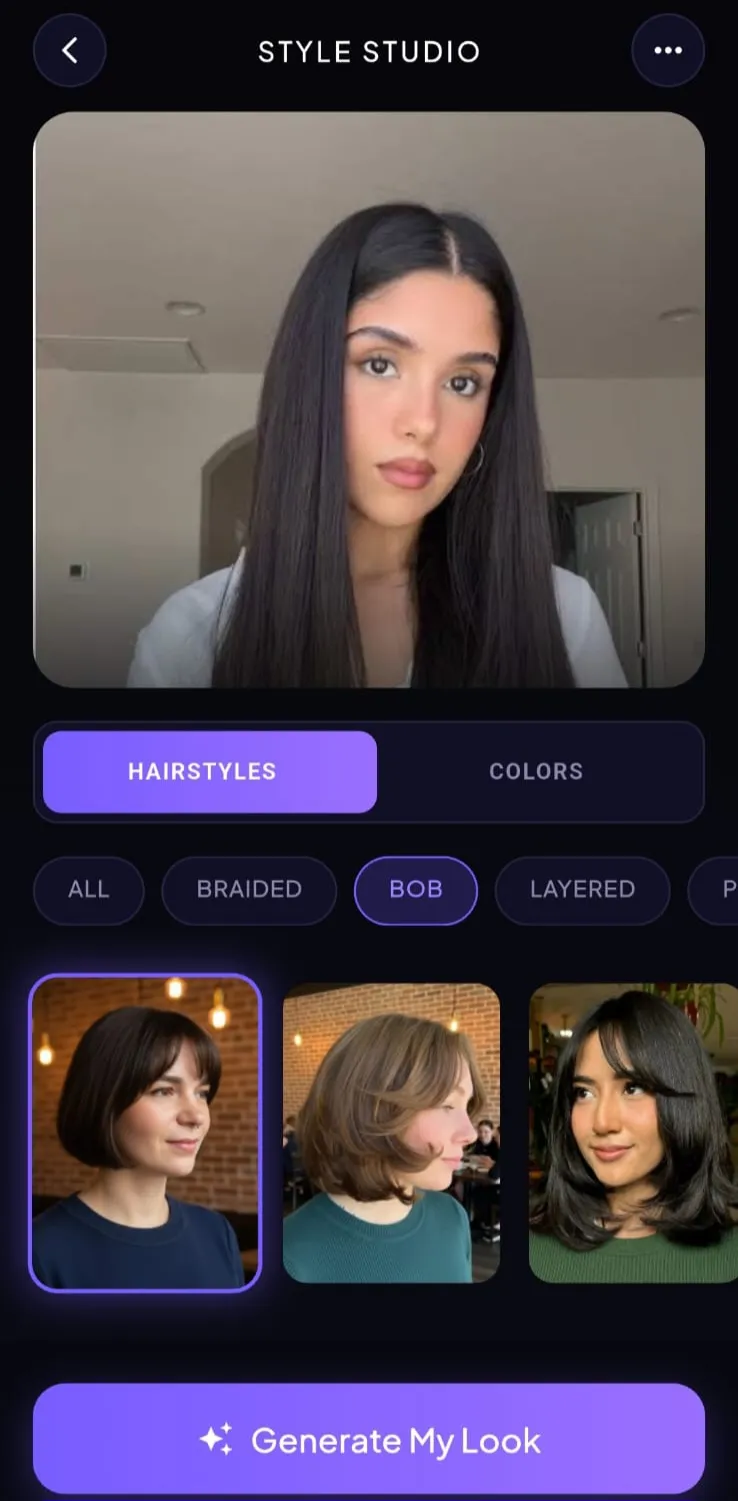
The difference between a bob and a lob can matter a lot with fine hair. Hairover analyzes your texture and density from a photo, then lets you try each length on your own face in Style Studio. Keep in mind that previews may show more volume than you’ll really get.
FAQ
What is the best haircut for fine hair?
A blunt bob or lob is usually the best starting point. A strong, even edge makes the ends look thicker. Keep layers minimal, and stop around the collarbone if you want the fullest look.
Is fine hair the same as thin hair?
No. Fine describes the width of each strand, while thin refers to how many strands you have. You can have a lot of fine hair, or only a little coarse hair.
Do layers work on fine hair?
A few long ones do. Many short layers can leave the bottom edge wispy, so ask your stylist to keep the layers long and limited, especially toward the ends.
Can fine hair have bangs?
Yes. Keep them light and don't take too much hair from the crown, since that leaves the sides looking thin. Curtain bangs are a popular option.